
12 Lessons from Designing Payments for Tomorrow’s Financial Systems
Lessons that scale: what we’ve learned and how to reuse it

Hi Everyone,
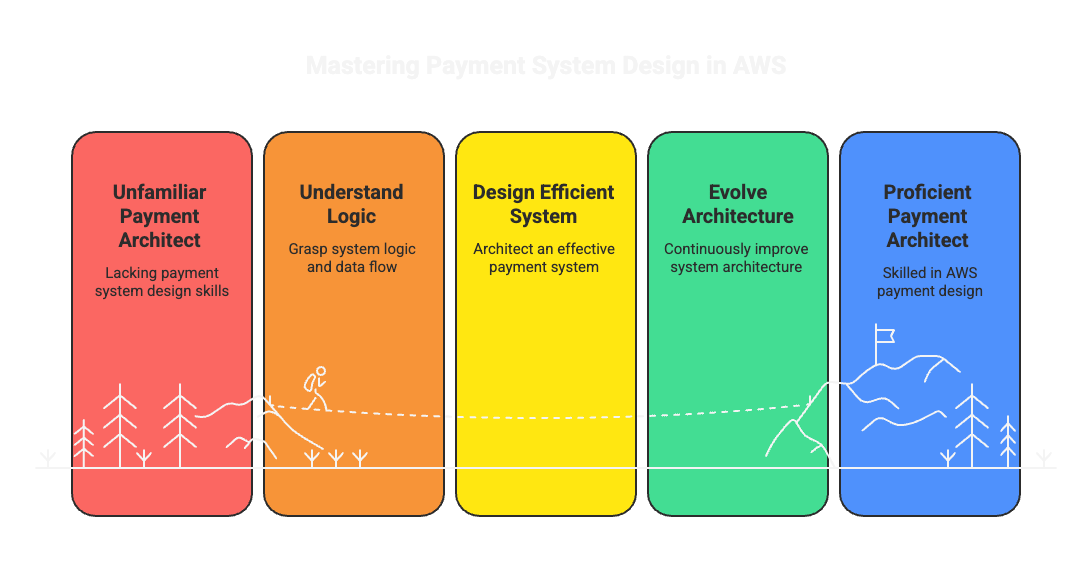
Over 12 parts of "Building Tomorrow's Financial Systems," we've deconstructed how to architect resilient payment platforms. But more importantly, you've learned to think systematically about complex financial infrastructure — skills that transfer to any system where reliability, compliance, and economics matter.
Don’t worry if you’ve missed parts of this series. You can catch up here:

The architect's mindset you've developed
Design for failure from day one. You've learned that payment systems aren't optimistic request-response cycles — they're state machines that must handle every possible failure mode gracefully. When you design your next system (payments or otherwise), you now think: "What breaks, when does it break, and how do we recover?"
Make everything observable and auditable. The orchestration layer concept — Step Functions as the single source of truth with everything else as evidence — teaches you to separate "what happened" from "how we know it happened." This thinking applies whether you're building payment flows, user onboarding, or any multi-step business process.
Cost as a first-class design input. You've learned to model unit economics upfront rather than bolt on cost optimisation later. The £0.000107 per transaction breakdown shows you how to map every architectural decision to its economic impact. This cost-per-unit thinking transforms how you evaluate technical choices in any domain.
Compliance by design, not retrofit. The series demonstrates embedding regulatory requirements into system architecture from the start. Whether it's PCI DSS, GDPR, or industry-specific regulations, you now approach compliance as an architectural constraint that shapes design decisions rather than a checklist applied afterward.
Technical patterns that changed how you architect
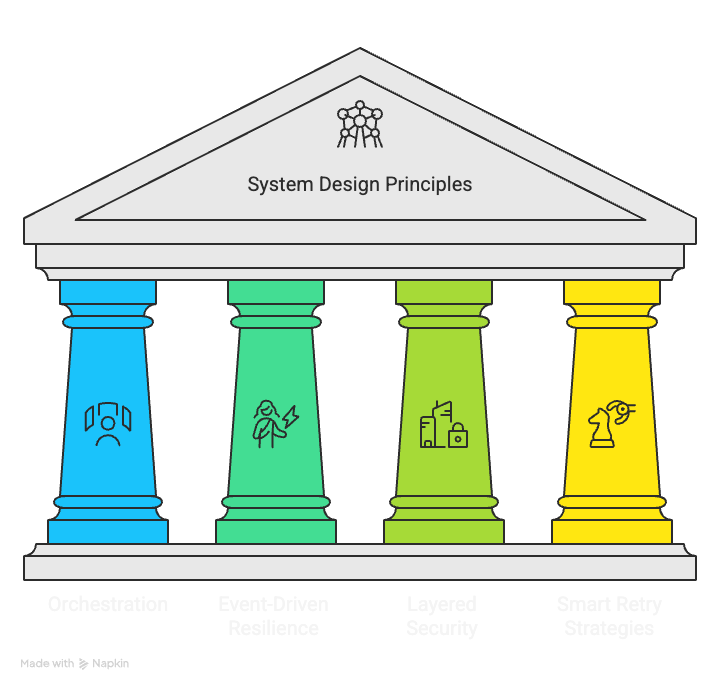
Orchestration over choreography. Instead of services calling each other directly (brittle chains), you've learned to centralise complex workflows in Step Functions. This pattern applies beyond payments — any multi-service business process benefits from explicit orchestration with built-in retry logic and visibility.
Event-driven resilience. The DynamoDB Streams → Kinesis → Analytics pipeline teaches you to build systems that react to state changes rather than polling for updates. You've learned to design for eventual consistency while maintaining strong consistency where it matters (like idempotency checks).
Layered security architecture. WAF → API Gateway → Lambda → VPC shows you how to implement defense in depth. Each layer handles different attack vectors: edge protection, authentication, business logic validation, and network isolation.
Smart retry strategies. You've learned that not all failures are equal — declined cards shouldn't retry, but gateway timeouts should use exponential backoff. This nuanced approach to error handling applies to any system that integrates with external services.
The business-technical bridge you can now cross
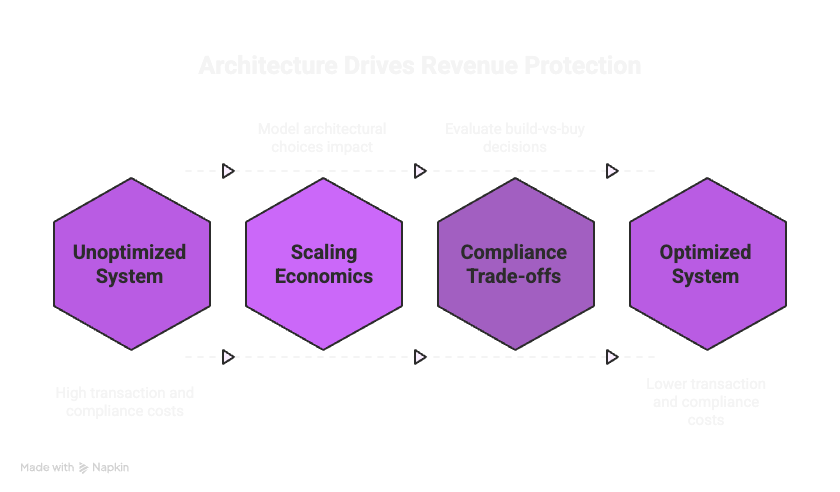
Revenue protection through architecture. You can now translate system reliability improvements into revenue impact for leadership conversations.
Scaling economics modeling. The progression from £0.006-£0.02 per transaction (early stage) to £0.001-£0.004 (optimised scale) gives you a framework for modeling how architectural choices affect unit economics as you grow.
Compliance cost trade-offs. Understanding that PCI DSS compliance adds £800-1200/month helps you evaluate build-vs-buy decisions. You've learned to scope compliance requirements to minimize cost while meeting regulatory obligations.
How you now approach system design
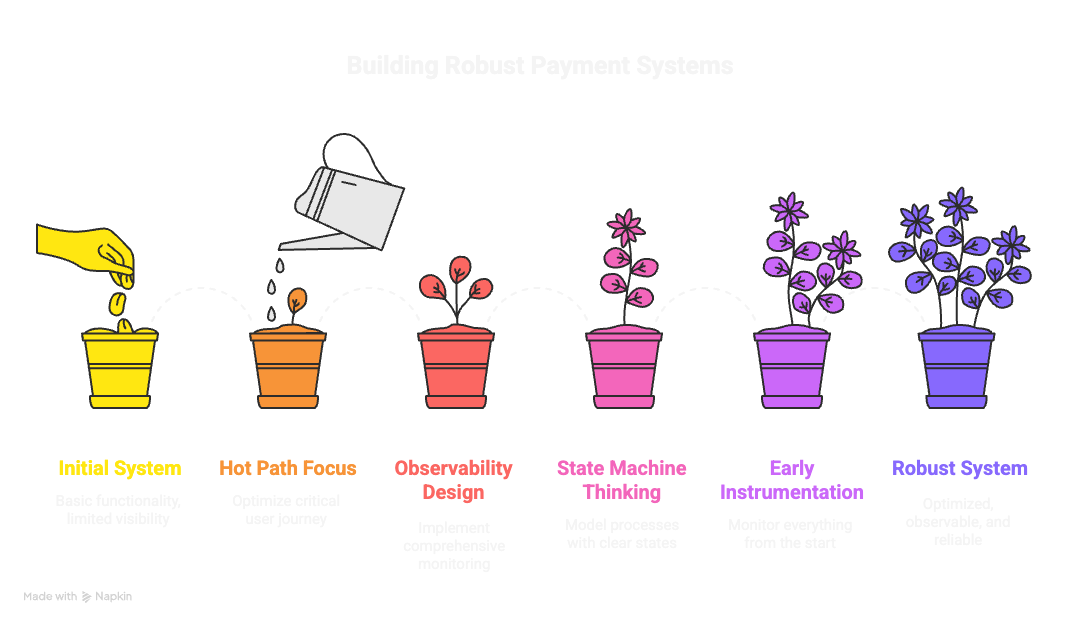
Start with the hot path. Map your critical user journey first — from API ingress through orchestration to data persistence — then optimise this path before adding features. The payment flow teaches you to identify and perfect your system's core value delivery mechanism.
Design for observability. You've learned that systems without visibility are unmanageable. CloudWatch metrics, Step Functions execution history, and audit trails aren't overhead — they're essential system components that prevent expensive debugging sessions and compliance failures.
Think in state machines. Complex business processes have explicit states and transitions. Whether processing payments, managing user lifecycles, or handling content approval workflows, you now model these as finite state machines with clear error handling at each transition.
Instrument everything from the start. The comprehensive monitoring approach — from API Gateway metrics to fraud model performance — shows you how to build systems that self-report their health. You've learned that instrumentation isn't a later phase activity.
The problem-solving framework you've internalised
Identify the invariants. In payments, money must be conserved and transactions must be idempotent. In any system, start by identifying what must always be true, then architect to maintain those invariants under all conditions.
Separate concerns clearly. The layered architecture (observability, entry, orchestration, data, analytics) teaches you to organize complexity into manageable components with clear responsibilities. This separation makes systems easier to reason about, test, and modify.
Plan for the edges. Payment systems fail in predictable ways — network timeouts, invalid cards, insufficient funds. You've learned to enumerate failure modes explicitly and design recovery paths for each. This systematic approach to edge cases prevents most production surprises.
Skills that transfer beyond payments
Multi-service choreography. Whether you're building e-commerce, healthcare, or logistics systems, you now understand how to coordinate multiple services without creating brittle dependencies.
Regulatory compliance architecture. The patterns for embedding audit trails, handling sensitive data, and meeting retention requirements apply to any regulated industry.
Cost-conscious design. The techniques for optimising AWS costs — right-sizing, lifecycle policies, reserved capacity — apply to any cloud-native system.
Operational excellence. The emphasis on monitoring, alerting, and automated recovery translates to any production system where downtime has business impact.
This series taught you to think about payments as a complex system with business, technical, and regulatory constraints. You've learned to balance competing requirements — performance vs cost, compliance vs simplicity, resilience vs complexity.
The economic modelling throughout the series — from transaction costs to scaling projections — teaches you to evaluate architectural decisions through a business lens. You can now have informed conversations about technical trade-offs with product managers, finance teams, and executives.
Your architect's toolbox now includes
Step Functions for complex workflows — not just payment processing, but any multi-step business process that needs reliability and visibility
DynamoDB design patterns — from idempotency keys to event sourcing, applicable to any high-throughput, low-latency data needs
Cost optimisation strategies — serverless vs containers decision frameworks, data lifecycle management, and observability cost controls
Compliance integration patterns — how to build audit trails, handle sensitive data, and meet retention requirements without retrofitting
Monitoring and alerting strategies — what to measure, when to alert, and how to build systems that self-diagnose problems
The mindset shift
You've moved from thinking about individual services to thinking about systems. Instead of optimising single components, you now consider how architectural decisions propagate through the entire stack — from user experience through business logic to cost and compliance implications.
This systems thinking, combined with the specific technical patterns and economic modelling skills, makes you a more strategic architect who can balance business requirements with technical constraints while building systems that scale gracefully and fail safely.
The payment domain taught you these skills because it demands them — but they apply wherever reliability, observability, and business impact matter.
Get Your Architecture Reviewed: 5 Auditable Improvements Guaranteed
Struggling with a system design? I'll review your architecture and provide 5 specific, auditable improvements based on the principles from this series.
Whether you're building payment systems, e-commerce platforms, or any mission-critical infrastructure, I'll analyse your:
✅ Cost optimisation opportunities (most systems can reduce costs by 30-60%)
✅ Reliability failure points (before they become outages)
✅ Compliance gaps (that could derail your roadmap)
✅ Monitoring blind spots (you can't fix what you can't see)
✅ Scaling bottlenecks (that will hit you at the worst possible time)
Here's how it works:
Submit your architecture (diagrams, key decisions, current challenges)
Get detailed analysis within 14 business days
Receive 5 prioritised recommendations
Optional 30-minute call to discuss the most critical improvements.
Limited to 2 reviews per month to ensure quality and depth.
Perfect for senior engineers preparing for architect roles, CTOs planning major system overhauls, or teams facing scaling challenges.